Reclaim Your Time
The power of Time Blocking and Self-Accountability
“How we spend our days is, of course, how we spend our lives.” - Annie Dillard, The Writing Life
TL;DR: If you don’t dictate how you spend your time, circumstances will decide for you. Time blocking in a flexible way allows you to decide on the trajectory and value of your life. Recommended steps are included if you’re new to the idea or want an updated approach.
Time freedom is one of the most powerful privileges you can reclaim. Not a luxury, a necessity.
Without free time, and without choosing to use your free time intentionally, you’re restricted in your ability to reach your full potential and limited in your efforts for fulfillment. So, how do we make the most of it?
I used to be a single mom, working 40+ hours per week, driving 2 hours per day between schools and offices and everything in between. I used to pray and wish and dream and hope for complete time freedom. The ability to choose, of my own accord, how to spend every second of my time.
When I suddenly got it, it almost ruined me.
Over the course of a few months, I relocated, merged households with my partner, and started working from home. No in-office 9-5 to clock into, no immediate health or family obligations other than school pickup. Complete and utter time freedom. I no longer had anyone to report to but myself.
I was lacking structure. I was lacking any semblance of a plan for my days. There was no discipline (dare I even say that word? 🤢) or direction anywhere to be found. And almost overnight, my biggest dream for my life, time freedom, became my biggest obstacle.
I recognized the amount of privilege I had at my fingertips and came up with a plan not to waste it. I constructed blocks of categories which included activities I knew would give me a sense of direction and ensure I was working towards my goals. I used “time blocking” to organize my days into a consistent routine while still allowing freedom and flexibility for my innate creative nature to exist. I created enough structure in my days to keep myself moving forward in the areas I want to grow in, and to keep myself away from spending time on habits that were becoming detrimental to my progress (looking at you, Doomscroll).
Here’s what it looks like:
Borrowing a concept from Tori Dunlap, businesswoman and author of Financial Feminist, she teaches her audience to use money as a tool to build the life they want. “You don’t have to stop spending money. You just have to stop spending money on shit you don’t care about,” Tori implores in her book. I’m encouraging you to do the same with your time. Being intentional and responsible with your time is the fastest way to ensure you are spending your days, and thus spending your life, how you want. But this isn’t the boring type of time blocking you’ll find described in a quick Google search. The goal here is to make it slightly more flexible and a lot more fun than it sounds, focusing on flexibility.
First step (1A): The assessment. In nursing school, we learned to assess before we took ANY action. In her book, Tori Dunlap teaches to observe your spending habits before making any other changes (unless they’re urgent). Knowledge of the current situation is required in order to determine what needs to change.
How are you currently spending your time? If your days are all identical and this is easy for you to identify quickly, I recommend writing down how you currently spend your time. If your days are a bit more fluid, track your time over the course of 2-4 weeks. Including time you spent doomscrolling! This will help you actually see where you are spending your time, and will give you an idea of what your future might look like if you don’t make any changes now.
After you assess, then review (1B). Quickest change to implement: What are you spending your time doing that you hate? Start there, and stop doing that (within reason of what is actually possible). Are you spending any time during your days or weeks doing things that bring you joy? If you don’t know what brings you joy, are you spending time exploring things that might? Have you made any progress on your bucket list items in the last month?
Once you’ve reviewed, you’re ready to start building. A NOTE TO KEEP IN MIND: I cannot tell you what to do, or how to spend your time. Only you know what is right for you. The examples I provide are working for me, but that doesn’t mean they’ll look the same for you.
Of course, you’re going to have obligations for your time (similar to financial obligations like rent and cell phone bills). Whether that’s employment, kids’ activities, or caring for a sick family member. Those might not be as easy to adjust.
But you also likely have some amount of free time each week. Decide what activities or practices bring value to your life, outside of the things you need to do and cannot change. The goal is to shift from wandering aimlessly or living victim to your circumstances to doing what feels good and what moves you closer to actually living the life you desire.
Now for the building:
2A - Block out the times for your day/week/month that you cannot change.
Work hours, commuting, personal & family commitments.
2B - Decide your most important direction(s), obligations, and activities; Start there.
A good place to begin might be scheduling time for the gym or whatever physical activity you enjoy or want to explore. Include time to meet up or chat with friends if nurturing those relationships is at the top of your list. Add a block (weekly, MINIMUM) for exploring hobbies (new or old). Find spaces to make sure your chores are getting taken care of. If you commute to work or activities, be sure to include your time here so you aren’t accidentally losing minutes or hours in your days.
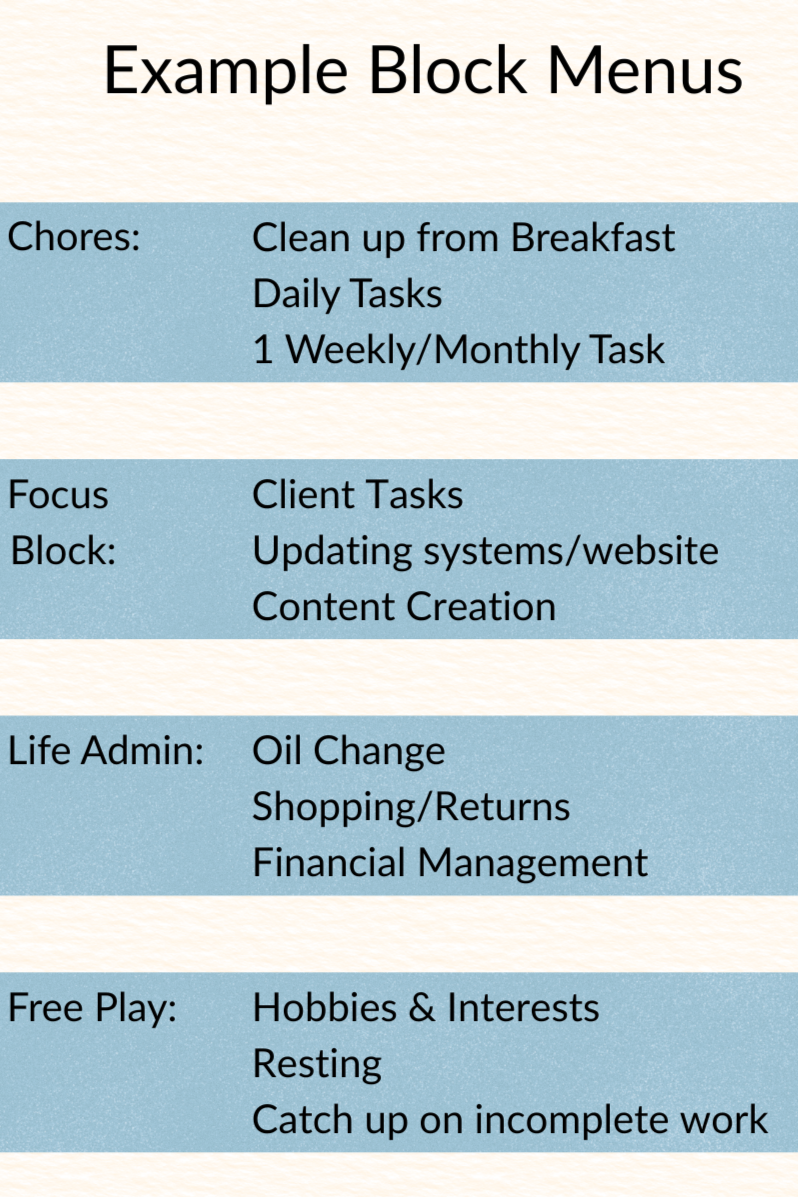
2B (The KEY) - Create “menus” for any vague blocks you may have included.
When I was deciding how to plan my time, I recognized a lot of…unknown. I have more free time now than I used to, and I wasn’t sure how to spend it. Trying to nail down the specifics of each block for each day was overwhelming, so I created menus of activities to choose from.
For example:
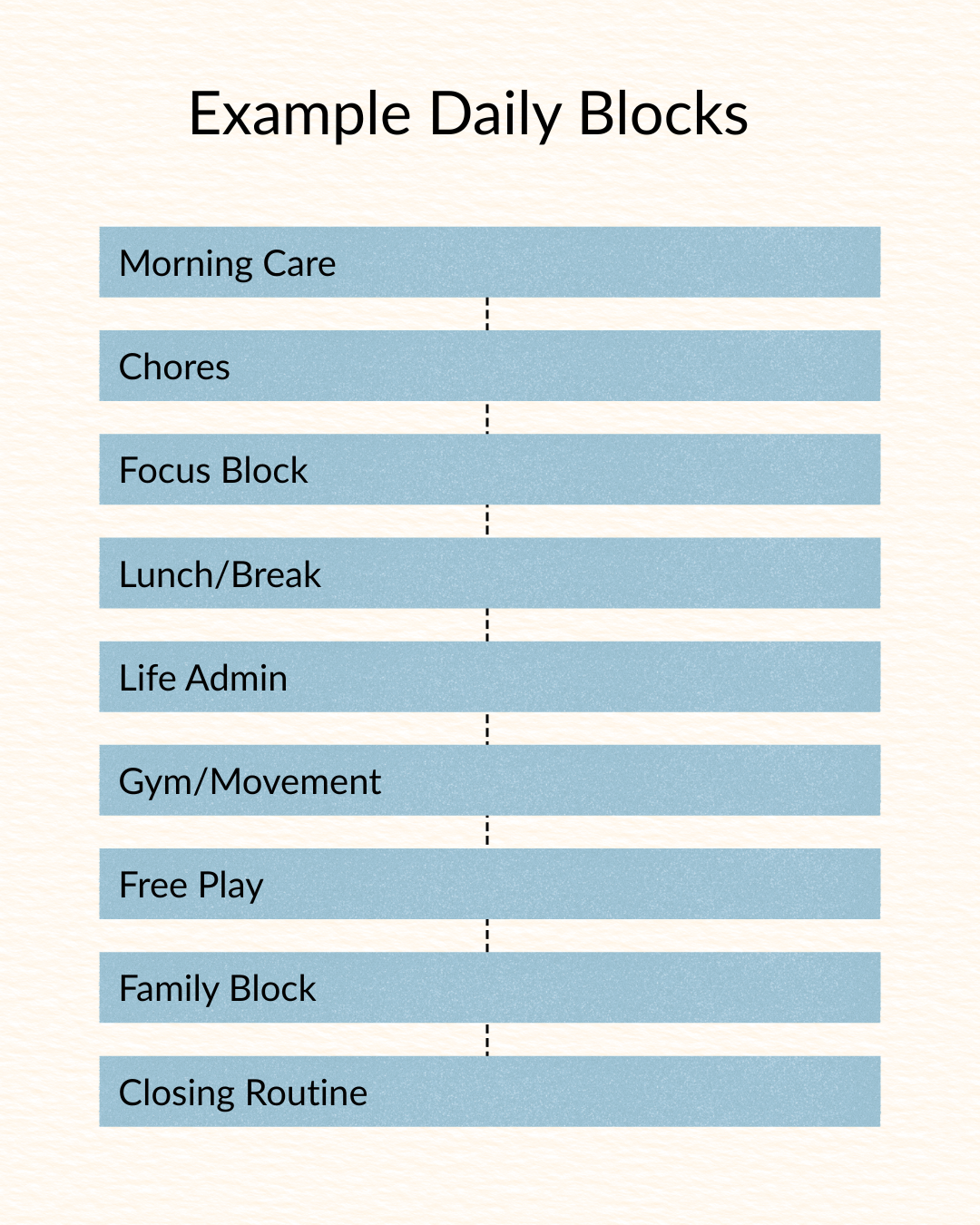
2C - Create the general flow of your day/week. (This will look different from the example if you clock in to a 9-5). What naturally feels good and right? Do you naturally wake up ready to conquer the world and wanna hit the gym first thing, or do you prefer to wake up slowly and want to focus on some self-care at the start of your day so it doesn’t get neglected?
This is an example of a daily flow for someone whose main source of income involves working online for a handful of hours each day:
3 - Test it out.
Utilize your new blocks to determine your actions over 1-2 weeks, and pay attention to what’s working and what’s not. Make changes accordingly.
The End Goal:
The beauty here is in recognizing the flexibility in application and the likelihood of sticking to the plan. We are not creating the end-all, be-all, only way you can spend your time for the rest of your life. We are building a new path to walk to allow more freedom and opportunity in the one life you have to live.
Taking accountability of how you’re spending your time by planning blocks allows for clarity and flexibility to determine if a task feels like it’s in the wrong spot. Or to recognize if you’re spending too much time doing something that you actually don’t want to do (again, coming for the chronic Doomscroll).
What I hope you take away from this: the overall effect is a greater sense of direction and guidance. After I started sticking to my blocks, I felt more in control of the trajectory of my life immediately.
The second effect I noticed was increased self-trust. Maybe you wake up in the morning and don’t really feel like getting out of bed and stretching right away, but you know that’s where stretching falls in your block system and you know why you set it up that way. You know what direction you’re moving in if you make sure you’re stretching each day. So you do it. And self-trust grows because you’re doing what you said you’re going to do. It became easier to hold myself accountable, indirectly increasing self-trust. I don’t ever want to ignore my blocks and let myself down.
Make no mistake, actually doing the things can be tricky sometimes. Who really wants to do the boring stuff on the regular? But, having those annoying necessities blocked out and approaching your days with the right mindset (“This is what block I’m in, this is what we are doing now”) reduces the chance of talking yourself out of what needs to be done. And having the menus you created in part 2B provides a safety net for the days you might really be struggling. Maybe going out to meet up with friends is just too much for your socialization block this week, but you can still opt to send some texts & memes to your loved ones while you rest on the couch instead. Relationship Nurturing Block: Complete
Reflect on the last bucket list you created or your New Years Resolutions if you made them, and note how many of those things you actively worked towards yesterday, in the last week, in the last month. Any progress? If they’re on your time block menu, you’re almost guaranteed to take action towards them.
Your time is a precioussss commodity, I argue one of the most precious you’ll ever have. Assessing the value of your current habits and obligations, and adjusting accordingly with intention, allows you to design a life you truly love. Never again will you wake up and wish you were somewhere or someone else. Imagine actually living the life you say you want. Imagine waking up and knowing where you’re going to be 1 year from now if you stick to the plan.
Now, get to blocking!